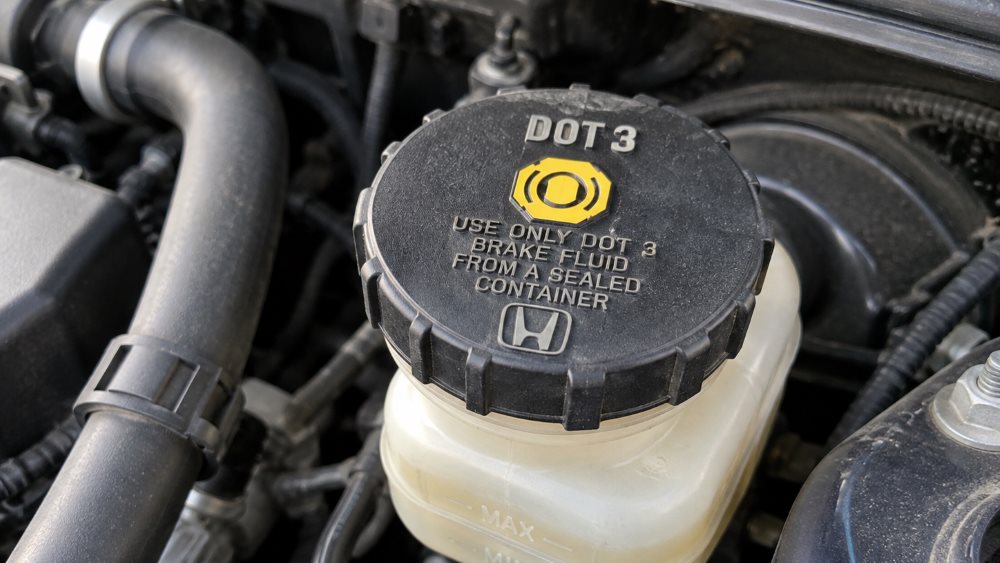
Brake fluid can absorb moisture over time whether a Honda is driven regularly or parked. For many recent Honda models, Maintenance Minder sub-item 7 calls for replacement, with a three-year fallback when no reminder appears within 36 months after item 7 was reset. Check the owner’s manual for your specific model and year. Illinois road salt generally affects exposed brake components from the outside; the sealed hydraulic fluid circuit is a separate concern.
Honda brake fluid maintenance guide. This educational overview references published Honda owner’s manuals and public-agency information. It does not replace model-specific instructions or a brake-system inspection. Content updated October 8, 2026.
Why does Honda replace brake fluid on time instead of mileage?
Because glycol-based DOT 3 brake fluid absorbs moisture over time, even in a vehicle that is rarely driven. FMVSS No. 116 includes labeling requirements concerning moisture contamination and container closure. Increased moisture can reduce the fluid’s boiling point, potentially affecting braking performance under high heat.
The federal standard specifies separate minimum equilibrium reflux boiling points for dry and laboratory-conditioned (wet) fluid. These are standardized test results, not measurements of the fluid currently in a particular vehicle.
Federal minimum boiling points for the two grades a Honda owner is likely to see on a bottle:
| Fluid grade | Fresh (dry) minimum | Moisture-laden (wet) minimum |
|---|---|---|
| DOT 3 (what Honda specifies) | 401°F (205°C) | 284°F (140°C) |
| DOT 4 | 446°F (230°C) | 311°F (155°C) |
Source: 49 CFR 571.116, Federal Motor Vehicle Safety Standard No. 116, sections S5.1.1, S5.1.2 and S6.2, retrieved October 8, 2026.
For DOT 3, the difference between the two regulatory minimums is 117°F. This is not a prediction of exactly how much the boiling point of your vehicle’s fluid will decrease. It illustrates why time and moisture exposure matter alongside mileage.
How often does a Honda need new brake fluid?
On many recent Honda models, Maintenance Minder sub-item 7 means “Replace brake fluid.” Some model-year owner’s manuals also specify a calendar backstop: if the reminder does not appear more than 36 months after item 7 was reset, replace the fluid every three years. Maintenance requirements can differ across model years and powertrains, so consult your vehicle’s actual manual.
Maintenance Minder timing depends on vehicle-specific service logic and operating conditions. The published brake-fluid calendar backstop provides an additional limit on applicable vehicles. If you are decoding a full code like B17, our Honda Maintenance Minder codes guide walks through every letter and number.
Here is what Honda's published guidance means in practice.
| Your situation | What Honda says | What to do |
|---|---|---|
| The Maintenance Minder shows a code with 7 in it | Sub-item 7: replace brake fluid | Have it done with that service visit |
| Item 7 was reset 36 months ago and has not come back | Change the brake fluid every 3 years | Book it on the calendar, even if the display is quiet |
| Honda with a manual specifying a fixed three-year interval | Follow that model’s published three-year instruction | Count 3 years from the last documented fluid change |
| You do not know when it was last done | No record means no starting point for the 3-year clock | Ask a qualified shop to review the service history and inspect the system; replacement may be prudent if the interval cannot be confirmed |
Sources: Honda owner's manual, To Use Maintenance Minder, retrieved October 8, 2026; Honda Owners Site maintenance schedule, 2008 model year, retrieved October 8, 2026. The all-electric Honda Prologue follows its own owner’s manual schedule, which this guide does not cover. Verify requirements for your exact model year.
Does Illinois road salt get into your brake fluid?
Not during normal operation of an intact, sealed brake hydraulic system. Road salt can corrode exposed metal brake lines, connections, calipers and bleeder screws from the outside. Moisture contamination of brake fluid is a different process that may contribute to internal corrosion. Both concerns deserve attention in a salt-belt vehicle.
The outside exposure is not small. The Illinois Department of Transportation reports using over 357,500 tons of salt statewide in the FY2026 winter season, across about 45,000 lane miles (retrieved October 8, 2026). The Lake County Division of Transportation says it pairs salt with liquid anti-ice deicing treatments throughout the winter on nearly 840 county highway lane miles (retrieved October 8, 2026).

FMVSS No. 116 includes laboratory corrosion-performance requirements for brake fluids against specified metals. Those tests help assess fluid properties under controlled conditions, but do not establish the condition of an individual vehicle’s brake lines, calipers or fluid.
In 2015, federal safety regulators advised owners in 20 cold-weather states, Illinois among them, to have the underside washed during and after winter and to have brake lines inspected for rust, as the Associated Press reported. That advisory focused on 2007 and older vehicles, but the habit still makes sense on a newer Honda.
What a salt-belt brake fluid job looks like. A technician may encounter corroded bleeder screws, fittings or exposed lines on vehicles driven through Illinois winters. The correct procedure depends on the vehicle and the condition of the components. Ask for a brake-line and fitting inspection during service; wheel removal and any additional work should be confirmed with the shop.
For the pad, rotor and caliper side of salt damage, see our Honda brake service guide for Lake County.
What a Honda brake fluid replacement includes
A proper brake-fluid replacement exchanges old hydraulic fluid for fresh fluid meeting the vehicle manufacturer’s specification. It is different from a simple reservoir top-off. The technician should follow the model-specific bleeding sequence, including any required ABS-related procedures. Typical service considerations include:
- The right fluid. Honda's owner's manual specifies Honda Heavy Duty Brake Fluid DOT 3 (retrieved October 8, 2026).
- A sealed container. Even Honda's temporary substitute rule says DOT 3 or DOT 4 from a sealed container only. Open bottles have already been absorbing moisture.
- The prescribed bleeding procedure. The shop follows Honda service information for the vehicle and addresses the required hydraulic circuits and any model-specific ABS procedures.
- The level set. Fluid should sit between the MIN and MAX marks on the side of the reservoir.
- Service documentation and reminder reset. Record the actual replacement date and reset item 7 when the model supports it. Resetting a reminder does not itself replace the fluid.
What you can skip. You do not need a brake fluid flush at every oil change, or because a quick-lube menu says so. For applicable models, follow item 7, the three-year backstop and any vehicle-specific guidance. Certain Honda manuals warn that non-Honda fluid may cause corrosion and recommend returning to the specified Honda DOT 3 fluid as soon as possible after use of an allowed temporary substitute. Do not assume that every non-Honda fluid situation is identical; check the manual and ask a technician.
We do not publish a fixed price for this service. Call (847) 595-5561 for a quote, and check our current service coupons before you book.
What happens if you put it off?
Moisture-contaminated brake fluid may have a lower boiling point. Under demanding braking conditions, vapor formation in the hydraulic circuit can impair pedal feel and braking effectiveness. Contamination can also contribute to corrosion over time. A soft or sinking brake pedal can have several causes and requires prompt professional diagnosis; do not assume brake fluid age is the only explanation.
Brake safety warning: If the brake pedal suddenly becomes soft or sinks, braking effectiveness decreases, or a brake-system warning remains illuminated, stop in a safe location as soon as possible. Do not continue driving a vehicle with suspected brake failure. Arrange professional assistance or towing and contact (847) 595-5561. Do not wait for a routine appointment.
Can an independent shop change Honda brake fluid?
Yes. A qualified independent shop can do this job well. Ask which fluid they will use and make sure it is DOT 3 to Honda's specification, never DOT 5, which Honda says is not compatible with the system. Ask for a dated service record and an appropriate Maintenance Minder reset where supported. Under U.S. warranty law, using an independent repair shop for routine maintenance does not by itself void a vehicle warranty; warranty coverage can still depend on the cause of a particular failure.
Honda dealership service departments have access to model-specific manufacturer procedures. A qualified independent shop using the correct fluid, equipment and procedure can also be an appropriate choice.
Frequently Asked Questions
Can I check my Honda's brake fluid myself?
Yes, the level at least. Open the hood and find the brake fluid reservoir. Honda's manual says the fluid should sit between the MIN and MAX marks on the side of it. If the level is at or below MIN, do not just add fluid. Honda says a low level calls for a dealer check for leaks or worn brake pads.
Can I top off a Honda with DOT 4 or DOT 5 brake fluid?
For the Honda models cited here, the owner’s manual permits DOT 3 or DOT 4 from a sealed container as a temporary substitute when Honda Heavy Duty Brake Fluid DOT 3 is unavailable. It specifically warns against DOT 5. Do not add or mix fluids without confirming the specification for your exact vehicle, and arrange the manual-recommended service after using a substitute.
Does the Illinois emissions test check my brakes?
No. The Illinois EPA emissions program reads your car's on-board diagnostic system to find malfunctioning emission control systems. It is an air quality test, not a brake inspection. In Illinois, keeping the brake fluid on Honda's 3-year schedule is entirely up to the owner. Source: Illinois EPA, Vehicle Emissions Testing, retrieved October 8, 2026.
Does a brake fluid change reset the Maintenance Minder?
Not automatically. The applicable Honda manual measures its 36-month fallback from the item 7 reset. A technician should reset the appropriate service reminder after the work, where supported, and provide a dated repair order. Keep that record to track when fluid was actually replaced.
Schedule Honda Brake Fluid Service in Libertyville
If item 7 is showing, or you cannot remember the last brake fluid change, book it now and restart the 3-year clock. Ask for a look at the brake lines while the wheels are off. For your full service calendar, see our Honda maintenance schedule guide.
Service: 872-664-4599
Address: 1111 S Milwaukee Ave, Libertyville, IL 60048
Published service hours: Monday-Thursday 6:30 AM-7:00 PM | Friday 6:30 AM-6:30 PM | Saturday 7:30 AM-4:00 PM | Sunday Closed (confirm before visiting)
Final service recommendations may vary by vehicle condition, model year and your service advisor's inspection. Offer terms and expiration dates may change without notice - verify current offers directly on our specials page before scheduling.
About Honda Libertyville Service Center
Honda Libertyville serves Libertyville and Lake County, Illinois, at 1111 S Milwaukee Ave, Libertyville, IL 60048. Contact the service department for vehicle-specific advice and current service availability.
Educational information based on published Honda owner’s manuals and public agency data. Published and updated October 8, 2026. Editorial review is not a substitute for a vehicle-specific technician inspection.