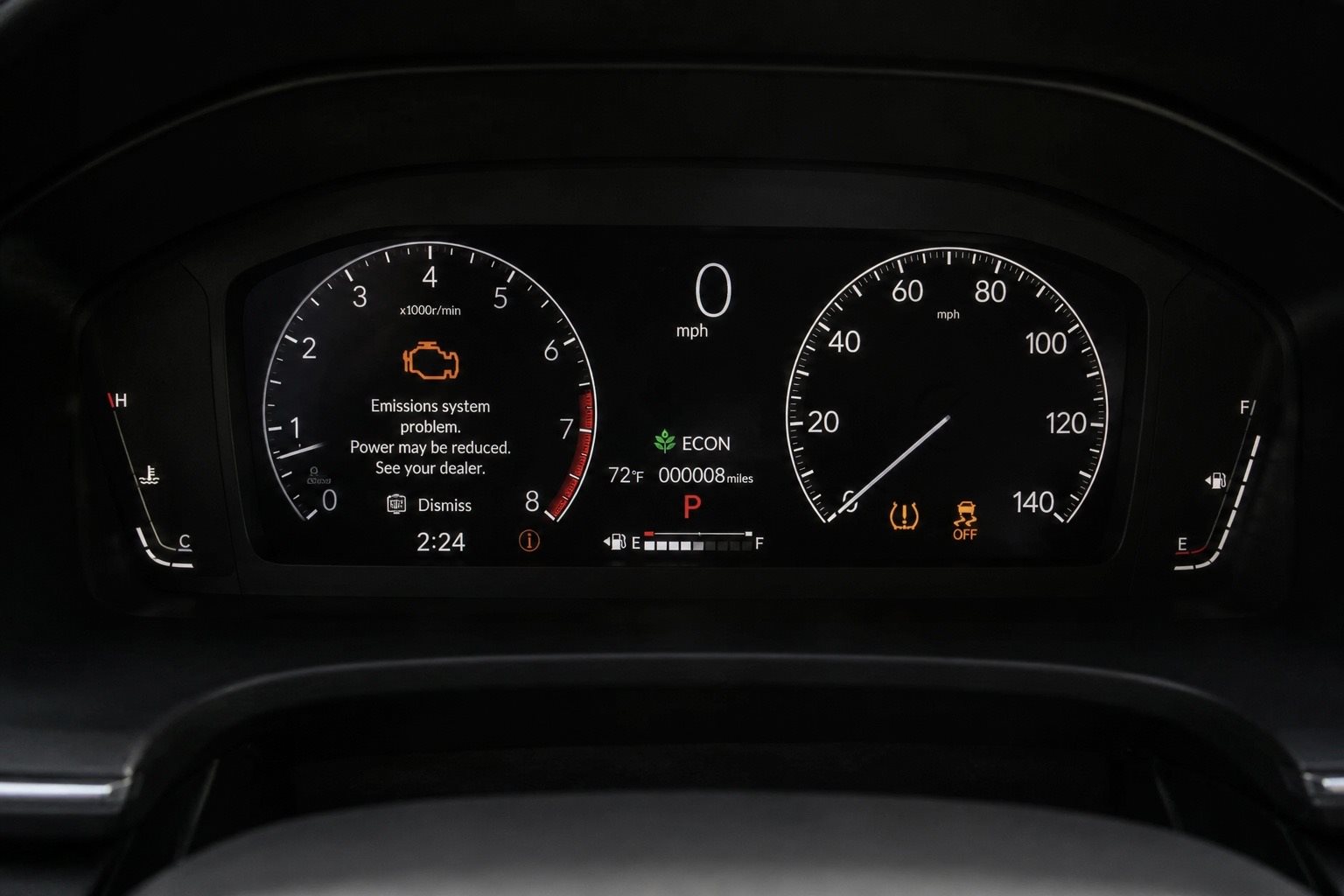
From the Honda Libertyville Service Center - Last reviewed June 2026. Our Honda-certified technicians at 1111 S Milwaukee Ave use Honda Diagnostic System (HDS) tooling and Genuine Honda Parts to diagnose and service every warning light that comes through our Lake County service bays. This guide reflects what we see daily across Civic, CR-V, Accord, Pilot, and Honda hybrid models.
Note: Warning-light behavior may vary by model year, trim, equipment, software version, and vehicle condition. Always consult your owner's manual for model-specific information. This article is general educational information and should not be used as a substitute for the owner's manual or a vehicle-specific diagnosis by a qualified technician.
A Honda dashboard warning light demands one immediate judgment call: how urgent is this? The color tells you. Red means stop driving as soon as it is safe to do so. Amber usually means the vehicle should be checked soon, but urgency depends on the specific light, whether it is flashing, and how the vehicle is driving. Green and blue are status indicators - no action required. Everything else is detail. This guide covers common Honda dashboard warning lights, with model-specific notes for the vehicles we see most in our Lake County bays and context on why northern Illinois winters make certain lights more common here than in warmer climates.
Note: The amber wrench icon is the Honda Maintenance Minder - a service interval reminder, not a warning light. It is covered separately in our Honda Maintenance Minder Codes guide.
Red Honda Warning Lights: Act Immediately
Safety warning: Red warning lights indicate a condition that may make the vehicle unsafe to continue driving or that can cause irreversible engine damage within minutes. Pull over safely and call (847) 595-5561 before continuing.
| Symbol | What It Means | What to Do |
|---|---|---|
| Oil Pressure Warning (oil can icon) |
Oil pressure has dropped critically low. Not an oil level warning - the pump cannot maintain pressure. Engine damage can occur within minutes of continued driving. | Stop driving as soon as it is safe to do so. Turn off the engine. Consider roadside assistance rather than restarting. |
| Engine Coolant Temperature (thermometer in water) |
Engine is overheating. Common causes: low coolant, failed water pump, stuck thermostat. In Lake County winters, a cracked hose or frozen coolant line can also trigger this. | Pull over, turn off engine. Do not open the radiator cap when hot. Call for service. |
| Charging System / Battery (battery icon) |
The battery warning light may indicate a problem with the charging system, which could involve the alternator, drive belt, wiring, or related components. The vehicle may run only briefly on battery reserve. | Reduce electrical load and stop in a safe place if the vehicle shows signs of stalling, loss of power steering, or electrical failure. If service is nearby, drive only if the vehicle is operating normally. |
| Brake System Warning (exclamation in circle) |
Can mean the parking brake is engaged, low brake fluid, or a brake system fault. Check the parking brake first. If released and the light remains, brake integrity may be compromised. | Confirm parking brake is fully released. If the parking brake is released and the light remains on, stop driving as soon as it is safe and have the brake system inspected before continuing. |
| Power Steering Warning (steering wheel with exclamation) |
Electric power steering fault. Steering still functions but requires significantly more effort - a safety concern at highway speeds. Common on cold starts on 2012-2018 Civics. | Schedule service promptly. Avoid highway speeds until inspected. |
| SRS / Airbag Warning (person with airbag icon) |
Airbag system fault. Airbags may not deploy in a collision. Separately, if your Honda is older, it is also worth checking for any open airbag recalls by VIN at NHTSA. | Schedule service. Airbag faults require HDS diagnosis -- not diagnosable with consumer scanners. |
Amber Honda Warning Lights: Schedule Service
| Symbol | What It Means | Urgency |
|---|---|---|
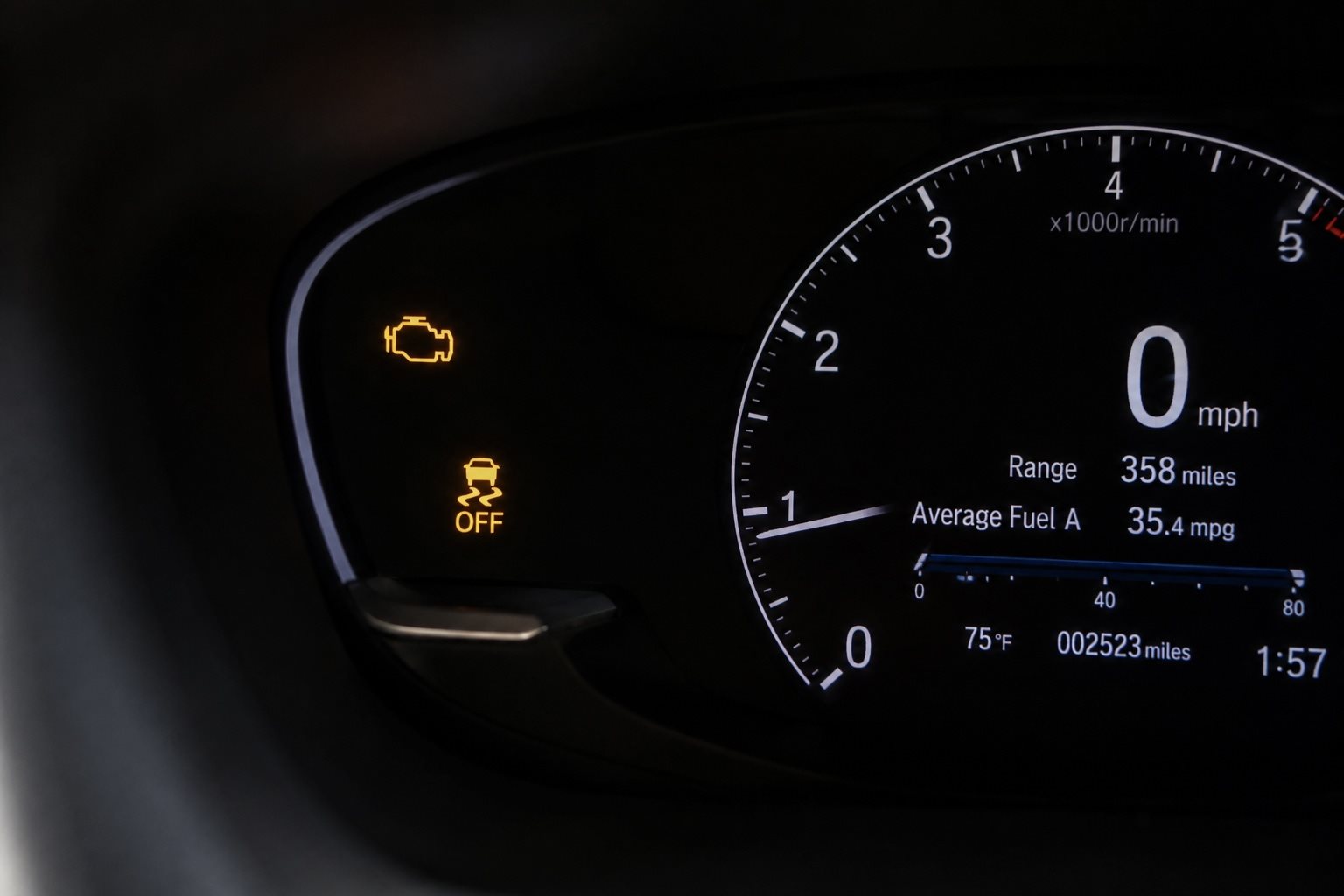
| Check Engine Light (MIL) (engine block outline) |
OBD-II system has stored a fault code. Covers everything from a loose gas cap (P0457) to a catalytic converter fault (P0420) to a cylinder misfire (P0301-P0306). Solid = investigate within the week. Flashing = active misfire damaging the catalytic converter. | Solid: a steady Check Engine Light often allows cautious driving for a short period, but the vehicle should be inspected promptly. Flashing: may indicate a severe engine misfire. Stop in a safe place, avoid driving aggressively, and arrange service immediately. |
| VSA (Vehicle Stability Assist) (car with skid lines) |
VSA system fault. Brief flashing during wheel slip on ice is normal - the system working. A constant amber VSA light means a sensor or actuator fault. A common contributing factor in Lake County: wheel speed sensor corrosion from road salt exposure. | Schedule within the week. Drive carefully in slippery conditions - stability assist is not functioning. |
| TPMS (tire cross-section with exclamation) |
TPMS is designed to alert when pressure is significantly below the recommended level, commonly around 25% or more below spec. A 20-degree overnight temperature drop in Lake County can drop tire pressure 4-5 PSI, triggering TPMS on tires that were fine the day before. Check pressure before assuming a puncture. | Check and inflate to spec first. If pressure is correct and light stays on, a TPMS sensor fault may be present - schedule service. |
| Honda Sensing Warning (radar waves icon) |
The Honda Sensing suite (CMBS, ACC, LKAS, RDM) has a fault or has been disabled. Snow or ice on the front radar sensor or windshield camera are the most common triggers in Lake County winters. On 2022+ Civics and 2023+ CR-Vs, the camera is especially sensitive to windshield contamination. | Clean the front bumper radar area and windshield. If the light clears after warmup, no service needed. If it persists, schedule - radar or camera calibration may be required. |
| Keyless Access / Immobilizer (car with key icon) |
Vehicle cannot detect the smart key, or a transponder fault is present. Most often the key fob battery is dead. Cold temperatures can cause intermittent key fob recognition issues on CR-V, Pilot, and Odyssey. | Replace key fob battery (CR2032 on most Honda fobs) first. If the light persists, schedule service. |
Note: After any windshield replacement on a Honda Sensing-equipped vehicle, the forward camera must be recalibrated by a Honda-certified technician. If you have recently had aftermarket windshield work done and now see Honda Sensing warnings, camera recalibration - not the camera itself - is commonly the fix.
Honda Sensing Warning Lights in Lake County Winters
Honda Sensing generates frequent winter-related warning calls in Lake County. Honda Sensing driver-assistance features are designed to assist the driver and do not replace attentive driving. The forward-facing millimeter-wave radar (located in the front grille, bumper, or emblem area depending on model) and the windshield-mounted camera both require clear sightlines to function. Snow buildup on I-94 or Route 176 can block the radar quickly. A frosted windshield in the camera zone will disable LKAS and CMBS before you leave the driveway.
The fix for most winter Honda Sensing warnings is operational, not mechanical: clear the front bumper of snow and ice, fully defrost the windshield including the camera area behind the rearview mirror, and restart the vehicle. If the warning clears, no service is needed. If it persists after a clean radar and clear glass, schedule service - the radar or camera may need calibration or replacement, and on any vehicle that has had a windshield replaced, recalibration by a Honda-certified technician is required before Honda Sensing will function correctly.
Warning Light Patterns by Model
Honda Civic
Certain 2016-2018 Civic 1.5T models and configurations have documented oil dilution concerns in cold-climate short-trip driving, with Honda extending warranty coverage on certain affected vehicles. If you see a check engine light on a Civic 1.5T and the oil smells of gasoline, this is worth flagging to our technicians - oil dilution in cold-climate short-trip conditions has been a known pattern on the 1.5T engine. On 2022+ Civics, the Honda Sensing camera is more sensitive to windshield contamination than prior generations, making LKAS and CMBS winter warnings more common. VSA and ABS warnings together on any Civic generation most often trace to wheel speed sensor corrosion from calcium chloride on Lake County roads.
Honda CR-V
Certain 2017-2018 CR-V 1.5T models and configurations were included in Honda's documented oil dilution warranty extension. The 2023+ CR-V Hybrid does not share this concern - the 2.0L Atkinson-cycle engine does not have the same cold-climate dilution behavior associated with the turbocharged 1.5T. On CR-V Hybrid models, an amber hybrid system warning does not automatically mean a high-voltage battery fault - it often indicates a 12-volt battery or sensor issue first. HDS diagnosis distinguishes between the two. TPMS is unusually common on CR-Vs in northern Illinois because many owners run all-season tires at summer pressures; always check the driver's door jamb sticker for the CR-V's front and rear pressure specs, which differ.
Honda Accord
For Accord 1.5T owners with short Libertyville-to-Vernon Hills commutes, our technicians often recommend not waiting for the Maintenance Minder to change oil in winter - short cold-weather trips limit the engine's ability to fully heat-cycle and burn off condensation in the oil. If the oil smells of gasoline at your next oil change, mention it at the service desk. On 2023+ Accords with the updated instrument cluster, the green radar icon indicating ACC standby is sometimes mistaken for a warning light. If the icon is green and the vehicle is behaving normally, no fault is present.
Honda Pilot
On the 2023+ fourth-generation Pilot, an amber transmission temperature warning may appear during heavy towing in summer heat - this is a normal protection indicator, not a fault. On all Pilot generations, the AWD system warning light indicates a fault in the Real Time AWD system; sustained wheel slip at boat launches or on snow can trigger a temporary thermal protection mode that limits rear-wheel torque and displays an amber indicator. This is the system protecting itself, not a malfunction. SRS warnings on 2016-2020 Pilots should be checked against open Takata recall status before assuming a new fault.
Honda Hybrid Models (CR-V Hybrid, Accord Hybrid, Civic Hybrid)
A common hybrid-specific warning call in our Lake County service bay involves CR-V Hybrid and Accord Hybrid models that will not enter READY mode on a cold morning. This is often related to the 12-volt auxiliary battery, not necessarily the high-voltage traction battery. When the 12V system cannot power the control modules, the hybrid system will not initialize - even with a fully charged traction battery. Do not attempt to jump a Honda hybrid by connecting to the orange high-voltage cables. Use the 12V terminals under the hood and call (847) 595-5561 before attempting a jump if you are unsure of the procedure. An amber hybrid system warning that appears while the vehicle is otherwise driving normally typically means a fault has been detected and the system has entered a protected operating mode - the fault is still active and still requires HDS diagnosis.
Why Lake County Winters Generate More Warning Lights
Illinois uses both rock salt and calcium chloride on Lake County roads from November through March. Calcium chloride can be more corrosive than sodium chloride and may contribute to wheel speed sensor connector degradation - which is why VSA and ABS lights together are commonly seen as a seasonal pattern in our bays. A corroded sensor will trigger both simultaneously because both systems share the same wheel speed inputs.
Sub-zero cold also accelerates 12-volt battery degradation. A battery that passed a load test in October may not deliver sufficient cold cranking amps in January. Our experienced technicians often recommend annual battery testing starting at year two for vehicles garaged in unheated spaces or equipped with high electrical loads. On hybrid models, the 12-volt failure-to-start pattern described above is commonly seen in our Lake County service bays during January and February.
Freeze-thaw cycles - Lake County roads commonly experience many freeze-thaw cycles through a winter season - are hard on front-end geometry. A pothole hit on Route 137 can shift front subframe alignment enough that the Honda Sensing forward camera detects the drift and triggers a warning. The fix is a front-end alignment check combined with camera recalibration, not camera replacement.
Frequently Asked Questions
Is it safe to drive with an amber Honda warning light on?
Usually yes for a short period - amber lights are prompts to schedule service, not immediate stop-and-park emergencies. The exception is a flashing check engine light, which indicates an active engine misfire that can damage the catalytic converter and should be treated with the same urgency as a red light.
Why did multiple warning lights come on at the same time?
Multiple simultaneous lights usually share a root cause. VSA and ABS lights together often point to a shared wheel speed sensor or related input issue. Honda Sensing and LKAS together typically mean the forward camera is blocked or uncalibrated. A weak 12-volt battery can trigger VSA, ABS, and Honda Sensing warnings simultaneously because all three depend on stable voltage. An HDS scan identifies the root cause faster than chasing individual lights.
Why does my Honda Sensing warning come on every winter morning but clear after a few minutes?
The forward camera needs a clear windshield to function. Interior fogging or exterior frost in the camera zone temporarily blocks its view. As the defroster clears the glass, the warning clears. This is normal in Lake County winters. If the warning does not clear after the windshield fully defrosts, schedule service.
Can I reset a Honda warning light myself?
The Maintenance Minder wrench resets via the procedure in our Maintenance Minder guide. TPMS will clear after inflating to spec and driving above 25 mph for a few minutes. For the check engine light: clearing the code without fixing the underlying fault will cause the light to return, and a recently-cleared code that hasn't completed OBD-II readiness monitors will cause an Illinois emissions test failure.
What is the difference between a flashing VSA light and a solid VSA light?
A flashing VSA light during braking or cornering on a slippery surface means the system is actively working - that is exactly what it should do on a Lake County winter road. A solid amber VSA light that stays on once driving normally means the VSA system itself has a fault and is not functioning. The flashing version is good news. The solid version requires service scheduling.
Does a warning light affect my Honda warranty?
The light itself does not. Continuing to drive with an oil pressure or coolant temperature warning until engine damage occurs creates a record of owner negligence that may complicate a warranty claim. Documenting warning light responses at a Honda-certified dealer creates a clearer service record for any subsequent claim. Warranty coverage depends on Honda warranty terms and vehicle condition.
Schedule Service at Honda Libertyville
Honda Express Service can handle routine inspections, battery tests, TPMS resets, and oil changes without an appointment. Check engine light scans, Honda Sensing calibration, and hybrid system diagnostics need a scheduled appointment so the right HDS tooling is ready when you arrive. Call (847) 595-5561 and we will tell you which category your light falls into before you drive over.
Service Department: (847) 595-5561
Service Hours: Mon-Thu 6:30 AM-7:00 PM | Fri 6:30 AM-6:30 PM | Sat 7:30 AM-4:00 PM | Sun Closed
Address: 1111 S Milwaukee Ave, Libertyville, IL 60048
About Honda Libertyville Service Center
Honda Libertyville is a factory-authorized Honda dealer serving Lake County and northern Illinois, operated by Murgado Automotive Group at 1111 S Milwaukee Ave in Libertyville. Our service department is staffed by Honda-certified technicians using Honda Diagnostic System (HDS) tooling and Genuine Honda Parts to diagnose and repair every Honda model - including Civic, CR-V, Accord, Pilot, and Honda hybrid and electrified vehicles where applicable. Honda Express Service provides routine maintenance and inspections for customers who prefer faster turnaround. Sunbit service financing is available for qualifying repairs.
This guide reflects diagnostic patterns observed in our Lake County service bays and is intended as educational information. Warning light behavior and urgency may vary by model year, trim, and individual vehicle condition - consult a Honda-certified technician for a vehicle-specific assessment. Published June 2026 · Last reviewed June 2026.